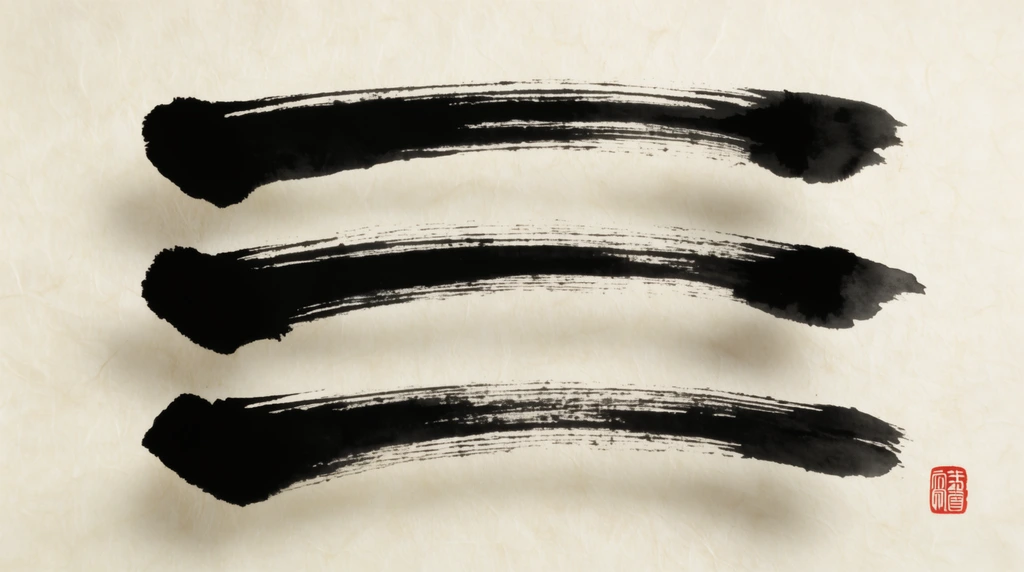
Eon and his dad start this lesson with a quick recap, and it shows just how much the early Chinese numbers stick. "Previously we learned two Chinese characters," his dad says — 一 (one) and 二 (two). Eon remembers exactly how they work: 一 is "just one stroke, left and right," and 二 is "two strokes, left and right" — with the second line "a little bit longer." They also remember the imagination trick that made them stick: a line can be a fallen tree trunk, and for 二 they had even drawn the Earth.
Now it's time for the next number. His dad asks, "What about three?" — and Eon doesn't even need to be told. "I already know three," he says. He traces it in the air: "It's like this, and then this." He's right: 三 (sān) is simply three horizontal lines.
一 = 1, 二 = 2, 三 = 3. Just count the strokes! That's the satisfying, easy-to-remember heart of the first three Chinese numbers.
Turning 三 into three wires
The fun part of these lessons is the memory picture — finding something real in the world that looks like the character. His dad offers a few ideas: "three snakes, three fallen trees, or three what?" Eon has his own answer ready: "three wires."
He almost talks himself out of it — "but wires are so hard" — then decides to try anyway. The AI drawing tool turns his idea into three neat cables, and they're a hit: "Oh, it's pretty good, huh? Pretty good wires." His dad notices they look like a familiar shape — "It's like a Type-C or USB wire" — and Eon agrees, labeling them "Type-C wire." Three lines, three cables. Easy to picture, easy to recall.
Before the next drawing, there's a tiny lesson in not being afraid to clear the screen. "I'm going to erase everything," his dad says, and Eon waves goodbye to their last picture: "Earth, goodbye." His dad reassures him — "Don't worry, save everything" — so the old work is kept safe before they start fresh.
A real tech tip: you can't see black on black
Then comes a genuinely useful discovery. The background is black, and Eon goes to draw 三... in black. His dad stops him with a rule worth remembering: "If you do black and draw three, nothing will happen — you won't be able to see it." So they switch to white instead, and the strokes pop right out.
If your ink is the same color as your background, it disappears. That idea is called contrast, and it's real — it matters in drawing, in design, and in making text easy to read.
Getting the lines just right
There's one more detail that makes 三 look correct instead of lopsided. Eon and his dad work out the spacing together. "Is this one shorter or longer in the middle?" his dad asks. The rule they land on: the middle line is shorter, and the last (bottom) line is the longest. It's the same balance idea from 二, just with one more line.
It doesn't come out perfect on the first go — "It's not too good, huh?" — but Eon keeps at it, clearly having fun: "I'm enjoying myself." After another try, the character clicks into place: "Whoa, that's pretty good, huh? Three wires, Type-C. That's three. Yeah." That's the whole loop of learning in one moment: try, notice it's a bit off, adjust, and get it right.
Try it
Write 一, 二, 三 in a row and count the lines out loud: 1, 2, 3. Make the bottom line the longest each time so your 三 looks balanced. Then find your own memory picture — three pencils, three jump ropes, or yes, three charging cables. Last challenge: guess what 四 (four) might look like. Do you think it's four lines? (Peek at the next lesson to find out — the answer has a twist!)