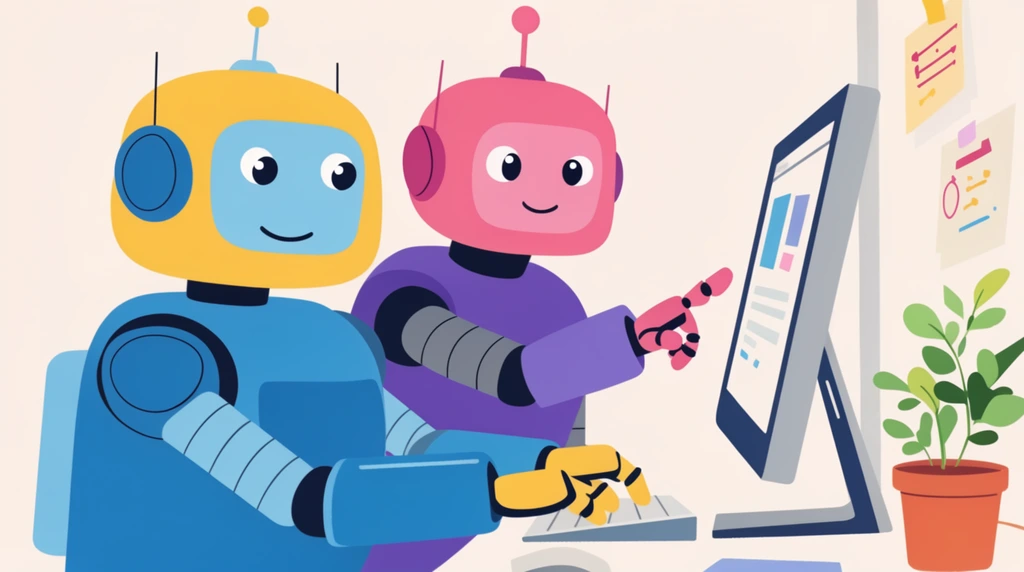
In this Coding Lab, Eon and Dad start by watching a short video about something real software teams do every day: pair programming. Then they put it to work on a block-coding puzzle where a bird has to reach a pig — and along the way Eon discovers a tool that turns a pile of repeated blocks into one tidy command.
Two people, two jobs
Pair programming means two people building one program together, and each has a role. One is the driver — the person who "controls the keyboard and mouse." The other is the navigator. Eon's dad gives the perfect picture: a navigator is "like a navigator look at the map, say hey you should go there, be aware" — and, importantly, the navigator catches "the driver's mistakes."
There's even a funny mix-up at the start. Dad says Eon is the driver now, and Eon protests "no, no, I, Mom drive!" — thinking of a real car. Dad clears it up: in coding, the driver is whoever has the keyboard. So Eon drives and Dad navigates, "pointing out some of the mistakes there, some of the things that should be paid special attention to."
Which way, and who actually moves?
Before any code runs, the pair has to think. The first question Dad asks isn't "what block?" — it's "North, south, west, or east?" Eon has to read the puzzle like a map. He learns that the right side is east and the left side is west.
There's a great moment of figuring things out. Eon points the bird the wrong way, and Dad doesn't just fix it — he says, "If you do that, try things out. You won't break it." Then comes a key realization: Eon wants the pig to move, but Dad reminds him, "you are the bird." You move yourself toward the goal, not the goal toward you. (And a fun fact slips in: a real pig is pink, but the artist drew this one green — "doesn't really matter.")
The slow way, then the loop
At first Eon solves it the hard way. To travel west, he runs one "go west," then needs more, so he stacks three west blocks: "one, two, three… you got it!" It works — but Dad says, "there's a better way of solving that problem. You see there's a repeat block there."
This is the heart of the lesson: a loop. Instead of dragging "go west" three separate times, you drag one west block inside a repeat block and tell it how many times. Eon struggles with the mouse — "how the heck, I can't drag it inside" — and Dad coaches him patiently: the repeat block "got a socket here," and you "wrap the action" inside it. They delete the extra west blocks, reset (Dad stresses you must reset before each new run), put one west inside repeat, and set the number.
Eon also learns to debug the count. With repeat set to 2, the bird comes up one short — "so we need more." Eon starts to add another block, but Dad stops him: "you don't need to add — you can just click this number and change." He bumps the repeat to 3, runs it, and the bird lands on the pig. Cheering!
Then Dad shows why loops matter. "What about, I want to repeat? You can change it to a very big number like 100… 2,000." To move ten times by hand you'd "click, drag, click, drag" ten times — but with a loop you "just choose repeat 10 times." That's the whole point of a loop: tell the computer to repeat the work so you don't do the manual work yourself.
Getting faster, level by level
As the puzzles continue, Eon gets quicker and starts solving them himself. He picks the right direction — "south, starting with the initial S" — wraps it in a repeat, and counts the steps "one, two, three." On a harder level he even learns that the turn block goes after the repeat, not inside it: Dad warns, "don't want to wrap things inside repeat… after all the repeat." By the end Dad cheers, "this is, like, all by yourself now!"
Try it
Find a maze or path game (or draw a grid on paper with a start and a goal). First, pair up: one person is the driver who moves the piece, the other is the navigator who reads ahead and calls out mistakes — then switch. Second, hunt for the loop. If you ever catch yourself doing the same step three, five, or ten times in a row, stop and ask: "Could one repeat do this instead?" Whenever the answer is yes, you're thinking like a real programmer.