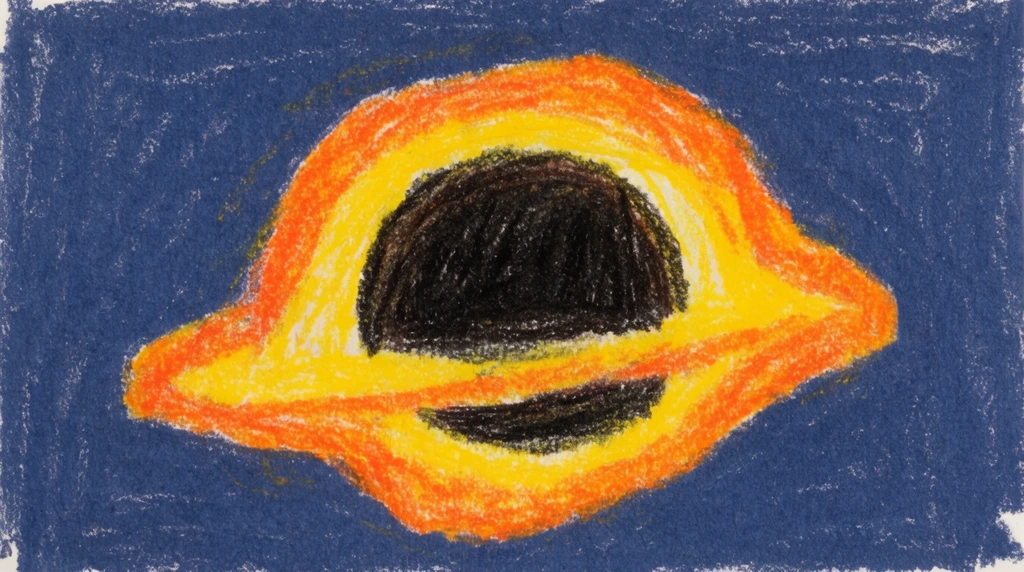
For the third part of his AI drawing adventure, Eon picks the coolest, hardest subject yet: a supermassive black hole. "Another big black hole," he says. "Super massive also." And the very first thing he discovers is that drawing one is trickier than it looks.
Step one: get the circle right (not too big!)
Eon starts to sketch and immediately runs into a problem: he draws the hole too big and it spills off the edge. "That's already pretty big," his dad points out, "look, here's already outside of the canvas." Eon gasps — "Oh my goodness, what does it happen?" — and they zoom back so the shape fits.
Then comes a second fix: the outline isn't round enough. "First we need to make it a little bit more circle-y," Eon says, and they smooth the lopsided edge into a clean circle. It's a small but real art lesson — start with the basic shape, get it round and centered, before adding any detail. A black hole, after all, is famously a near-perfect circle.
Two parts: the black center and the flat glowing disc
Once the circle is right, Eon decides what to call his picture: he names it "interstellar black." That's a great clue, because the look he's after comes straight from real science (and the movie Interstellar).
A black hole has two parts, and Eon draws both:
- The dark center — so heavy that not even light can escape, which is why it looks perfectly black.
- A bright ring wrapped around it. Eon describes it perfectly without even meaning to: it's "like a creature that is so flat," going "pretty wide" around the hole. Scientists call that the accretion disc — a band of super-hot gas and dust, spinning around the hole and glowing. It really is flat, like a glowing dinner plate with the black hole at the center.
That bright, flat ring is the part we can actually see. The black hole itself is invisible — what shows up in real photos and in Interstellar is the blazing disc around the edge.
When the AI goes wild
Because an AI is turning Eon's sketch into a picture, things quickly get out of control — in the best way. Suddenly there are planets orbiting the black hole. "Oh, the planet's orbiting a black hole now!" Eon shouts. Then the Earth pops in and vanishes, and the Sun falls straight into the hole and goes pixelated: "The sun is inside the freaking black hole!"
It's chaotic and funny, but it accidentally teaches something true: a black hole's gravity is so strong it pulls nearby things toward it — planets, gas, even whole stars. At one point Eon watches the gas streaming in and says, "All the gas, all of it — that's really cool."
Realistic or cartoon? Eon makes the call
Near the end, the AI keeps offering different versions, and Eon and his dad debate which to keep. Eon keeps asking for the "realistic" one, then changes his mind when realistic starts looking weird ("this is getting worse and worse, bro"). Finally they compare two side by side — "This one? Or this one?" — and Eon picks his favorite. That back-and-forth is part of art too: try options, compare them, and choose the one you like best.
Try it
Draw a black hole in two steps. First, a round black circle — and don't let it run off the page (Eon's biggest mistake!). Then don't stop at the dot: wrap a wide, flat, glowing ring all the way around it. The ring is what turns a plain black circle into a real-looking black hole. Bonus: draw a tiny planet caught in the swirl, getting pulled in.