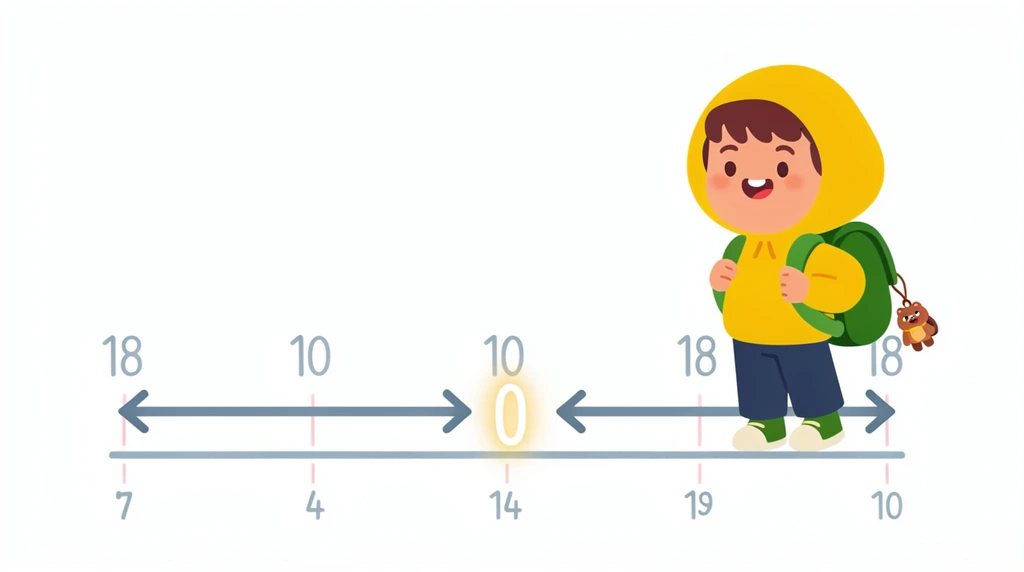
"Absolute value" sounds like a scary, grown-up math phrase. But in this video, Eon's dad does something clever: he turns it into a game he programmed himself — complete with his own face and Eon's profile as the two characters — and by the end, the scary words mean something simple and obvious.
A game where Dad is the school
In the program, Eon's dad puts himself right in the middle of a number line, at position 0, and labels it the math school. Eon is a little character somewhere out on the axis. The axis runs from −20 on the far left to +20 on the far right, marked at −15, −10, −5, 0, 5, 10, 15, 20.
The first challenge is just to get to school. "Remember, you can click and drag," Dad says — and that part is genuinely hard. The mouse is tricky to control, so Eon nudges his character a little left, a little right ("Snap a little bit left… a little bit") until — "You are at school!" Then Dad clicks "new distance," and Eon teleports to a brand-new random spot. The whole lesson becomes one playful, repeated question:
"How far away are you from me?"
Reading the number line: where exactly is 11?
Eon lands on 11, and instead of just naming it, the two of them reason about it. Eleven is "one bigger than 10," but it's also "less than 15" — so it sits between 10 and 15, a little closer to 10. They do it again when Eon teleports to 17: that's bigger than 15 but still less than 20, so it lands in the top stretch of the line.
This is a great habit all by itself: a number isn't just a name, it's a place. Knowing 17 is "past 15, not yet 20" means you can picture exactly where it lives.
"Far away" isn't a good enough answer
With Eon sitting at 17 and Dad at 0, Dad asks the question — and here's where the math sneaks in. The easy answer is "I'm far away!" But Dad pushes back: how far? "Far away" isn't precise. The honest answer is a number: he's 17 away.
Where does the 17 come from? You take your position and subtract Dad's: 17 − 0 = 17. That's the distance between you and me, Dad explains — and that is exactly why math has to come into play. If you can only say "near" or "far," nobody knows where you really are. Give the exact number and you've pinned your spot perfectly. (Eon riffs that it could be 17 meters or even 17 light-years — the same idea works at any scale.)
The surprise: +17 and −17 are equally far
Then Dad does something "crazy": he drags Eon all the way over to the left side of zero. "Where are you now?" Eon first guesses −15… −16… −18, then reads the axis carefully and gets it: −17.
Same question as before: how far from school? Eon answers 17 again — and he's right! Even though −17 and +17 sit on opposite sides of zero, the distance back to school at 0 is exactly the same.
This is the whole heart of absolute value: distance doesn't care which direction you went. Seventeen steps left or seventeen steps right — either way, you are 17 away.
To feel it on a smaller number, they try −5: the distance to 0 is 5. At +5, the distance is also 5. Plus or minus, the distance is the same.
Writing it down: the two little bars
So how do mathematicians write "the distance from zero"? Dad shows the symbol: put two straight bars around the number.
- |8| = 8
- |15| = 15
- |−12| = 12 — because −12 is twelve steps from zero
- |−20| = 20
Look at the pattern and the trick jumps out:
- If the number is already positive, absolute value leaves it alone.
- If the number is negative, absolute value strips off the minus sign — because a distance can never be negative.
Or, as Eon's dad puts it, you just "get rid of the minus." So |−20| = 20.
Why distance matters in real life
Eon's dad loves to zoom out to space — so he does. Imagine the number line is space, with the Sun at zero and Earth out along it. How far is Earth from the Sun? Eon already knows: about 1 AU. Dad fills in what AU stands for — an astronomical unit, the special "ruler" astronomers use for distances between planets. And notice: whether you measure Sun-to-Earth or Earth-to-Sun, the distance is the same. Direction doesn't change it. Distance shows up everywhere — how far to school, how far across the room, how far to another planet.
The big idea in two lines
- A number's sign (+ or −) tells you which direction you are from zero.
- Its absolute value tells you how far from zero — and that's always positive (or zero).
Try it yourself
- What is |−9|? (9 — it sits 9 steps from zero.)
- Eon teleports to −6 and school is at 0. How far does he travel to get back? (6 steps.)
- Picture the line: is 16 closer to 15 or to 20? (Closer to 15 — just one step past it.)
- Trickier: which is further from zero, −20 or +15? (−20 — it's 20 away, while +15 is only 15 away. The minus sign doesn't make it "smaller" in distance!)