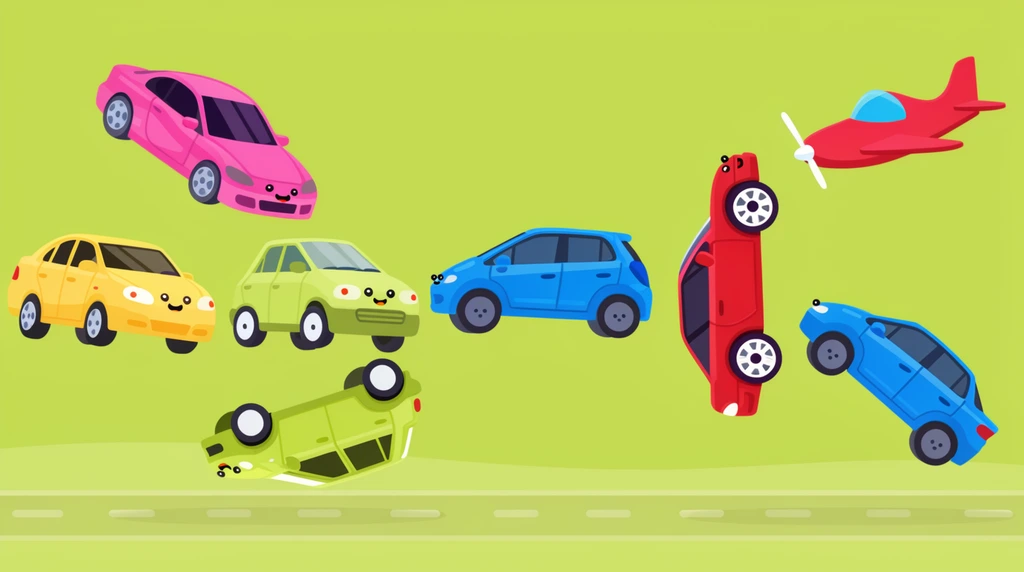
In this video, Eon opens up BeamNG.drive — a game that isn't really about winning a race. It's a giant physics sandbox, a digital playground where you spawn cars and planes and then watch what the computer does to them. Eon spends the whole video poking at the rules of that world: starting a plane engine, smashing a blue super car into things, and — the best part — grabbing the gravity slider and cranking it to settings that don't exist on Earth. He crashes constantly ("I mess up every single time!"), but every crash teaches him something. That's exactly how a real scientist works.
A plane, a super car, and a whole lot of crashing
Eon starts with a plane. He presses keys to start the engine and tries to get it moving, narrating the struggle out loud: "Is it moving yet? Is it moving yet?" The plane creeps forward "slowly but surely," and he switches to a third-person view with the C key so he can see it from the outside. This is a real skill in 3D games: the camera and the thing you control are two different things. When he couldn't tell what was happening, changing the camera angle gave him new information.
Then he gets playful. He spawns a car to "smash into the plane," cycles through vehicles — a monster truck, a muscle car — and finally picks "a blue super car." He keeps overshooting his target: "We just passed it... How do I even pass that plane? I want to aim direction." Aiming a fast-moving car at a target is harder than it looks, because by the time you react, you've already moved. That gap between deciding and doing is something every driver, pilot, and gamer has to learn to predict.
The computer drives, too: meeting the AI cars
Partway through, Eon notices something surprising. Other cars are moving on their own. "They're AI cars!" he says. "AI cars, I'm telling you, they're no person." AI stands for artificial intelligence — it means the computer is driving those cars itself, following its own little set of rules, with no human at the wheel.
Eon tests this idea like a scientist. He tries to push an AI car, honks, and tells it to stop — but it keeps driving its own path. He even jokes that they're "AI cops" and that you'd "need your license." What he's really discovering is that some things in a game obey you, and some things obey their own program. The AI cars don't care that he's there; they just keep following their instructions. That's a real and important idea about how computers work.
Turning gravity into a toggle
The coolest experiment is when Eon finds the gravity setting. In the real world, gravity is the force that pulls everything toward the ground — it's why a dropped ball falls and why you don't float away. BeamNG lets you change how strong that force is, and Eon tries every option:
- Negative gravity: instead of falling down, everything gets pulled up. "All my buddies sucked me out... almost sucked out to the blue sky!" Doors and dummies fly off the vehicles toward the sky.
- Zero gravity: nothing falls at all. Cars, planes, and even a tiny dot in the distance just float. "Everything just floats!"
- Moon gravity: weaker than Earth's, so things fall slowly and gently.
- Earth gravity: back to normal — everything drops the way it should.
He notices a clever trick, too. When he flies a vehicle around with the W key and then levels it out, the game "resets back." He's learning the program's rules by watching cause and effect: do this, and that happens.
He even crash-lands a plane in zero gravity, watching the warnings flash and the cockpit spin: "The landing gear tear itself apart... now the plane's flying with one wing." A wing or a door breaking off isn't random — the game is calculating the force of each impact and deciding how much damage that part can take. That's the "simulation" doing its job.
When the experiment doesn't work
Here's the most grown-up part. After a break, Eon comes back and the gravity trick suddenly stops working. "I click negative... nothing happens. It should float, but the car is not floating." He doesn't give up or pretend it's fine. He reasons through it out loud: "I think it's a bug, something a bug for the game." Then he tests his idea — he changes the map, tries a different vehicle, and checks the gravity number (9.9). A bug is when a program does something its makers didn't intend. Noticing that something should happen but doesn't, and then guessing why, is exactly the kind of careful thinking that makes a good engineer.
Try it
You don't need a video game to experiment with gravity. Try this with a grown-up's okay:
- Drop test. Hold a crumpled ball of paper and a flat, open sheet of paper at the same height. Drop them together. Which lands first? (The crumpled one — flat paper catches more air, like a parachute.)
- Change the "settings." Now crumple both sheets the same way and drop them together. Do they land at the same time now? You just changed one thing and ran the experiment again — like Eon flipping the gravity slider.
- Imagine the moon. On the Moon, gravity is about 1/6 as strong as Earth's. If you can jump 1 step high here, you could jump about 6 steps high there. Draw a picture of how a super-jump on the Moon would look.
The big idea: Eon's video is one long experiment. He tries something, it crashes, he changes one thing, and he tries again. Whether you're flipping gravity in a game or dropping paper at home, that loop — try, watch, adjust, repeat — is how you figure out how the world really works.