A new Universe Sandbox update just dropped, and Eon turns it into a full-on physics lab. The plan is simple and a little wild: keep doing bigger and bigger experiments on the Earth to find out what it really takes to break a planet. Along the way he bumps into some of the biggest ideas in real astronomy — spin, gravity, black holes, and atmospheres — without ever opening a textbook.
Spin the Earth until it bulges
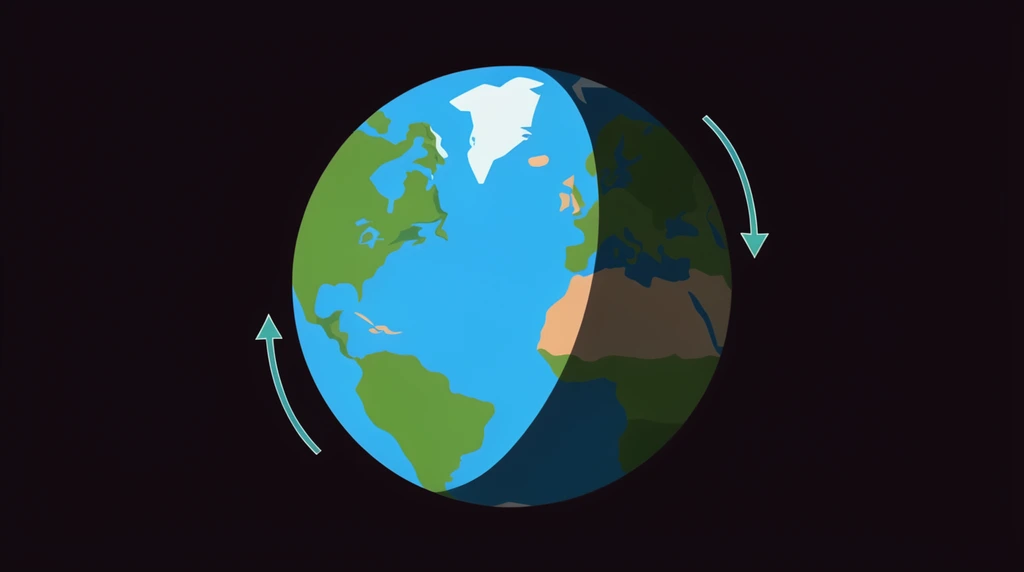
The first experiment is to grab the Earth and spin it. Eon learns the trick: open Tools → spin rate, then dial the rotation up and even pick a direction. He cranks it way too fast and something amazing happens — "the water is getting pushed to the equator because it's spinning so fast." Then the whole planet starts to bulge in the middle.
That is real physics. When something spins, it tries to fling its outer parts straight outward (Eon calls it the "eccentric force" — the real word is centrifugal effect). Gravity is the only thing holding the planet together. Spin slow, and gravity wins. Spin fast enough, and the outward push gets stronger than gravity's pull near the equator — so the oceans pile up there and the planet stretches into an egg shape. Fun fact: the real Earth bulges a tiny bit at the equator for exactly this reason.
Turning Pluto into a black hole
Next Eon goes after Pluto. He wants to "crush Pluto into a black hole," and the way he does it teaches what a black hole actually is. Universe Sandbox lets him lock the mass and then shrink the radius down and down — until Pluto's radius reads 7.2 centimeters. All of Pluto's matter, squeezed into a ball smaller than a soccer ball. At that point it snaps into a black hole.
That is the real recipe: a black hole isn't "extra" stuff, it's the same mass packed into an unbelievably tiny space. And because gravity gets stronger the closer you are, a tiny dense object has monster gravity right at its surface. Eon watches it happen live — "every planet has just been dragged into Pluto," he says, as the orbits bend and the whole solar system pours into the little black hole. Scary, and exactly how gravity works.
The atmosphere fights back
Then Eon starts throwing asteroids at Earth, and he discovers our planet has a shield. A small "random asteroid" comes screaming in — and burns up. "I think the atmosphere destroyed it. It never hit us." When a rock the size of a U.S. state comes in, it still struggles against the air, glowing with fire on the way down.
This is real: Earth's atmosphere is a layer of gas that rubbing-fast space rocks slam into, heating up and burning before they reach the ground. Most small meteors never make it. But Eon also sees the limit — a big enough impact in the ocean sends out a giant shock wave and could trigger tsunamis. Small shield, big rock: the shield loses.
What actually destroys a planet
Here's the smartest discovery in the whole video. Eon keeps making his objects bigger to destroy Earth — and Earth keeps surviving! So he changes his strategy: "you can lock the radius so it's still pretty small, but you increase the mass." Same little size, way more mass crammed in, so the density shoots up. That hits much harder.
It still takes a lot — he throws the Great Pyramid at the speed of light, then whole planets like Mercury and Mars. When Mars finally slams in, the energy is so huge that Earth melts and merges into a star bigger than the Sun, with enough gravity to drag the real Sun apart. The lesson underneath the chaos: in space, mass and speed carry the energy, not how big something looks on screen.
One more clever test: Eon tilts the Earth to an extreme angle so one side always faces the Sun. Soon "all the plants are dead… because one side always faces the sun," its oceans boiling away into thick clouds. That is a real danger for planets that get stuck facing their star — half scorched, half frozen.
Try it
Be a spinning planet. Hold a small cup with a little water in it, stand up, and spin slowly — then faster. Watch the water try to climb up the sides and "escape" outward as you speed up. That outward push is the same effect that made Eon's Earth bulge at the equator. (Spin gently and over a sink — you're testing physics, not making a mess!) Then ask yourself: what's the one force that keeps a real planet from flying apart? (Hint: it starts with g.)