Eon starts this one fired up: he grabs a brand-new Tesla — "I'm really fast!" — turns down his phone so the sound isn't too loud, and picks the blue car to start racing. Every track he tries is "really, really hard," and at first he's just trying to survive the road. But this video isn't really about going fast. Across several races, Eon slowly figures out the system hiding underneath the game: how the boost actually works, when not to press it, and what to do with all the money he wins. The fun part is watching him get it a little wrong, then crack the rule.
Drifting fills the boost
The first big discovery is that the nitrogen boost isn't free — you have to earn it. Someone reminds him about the "nitrogen boost," and then Eon finds the trick: *"if you tap the left key... oh, drift! Left drift. Hold to drift."* When he holds the turn and slides the car sideways, something starts to happen to the meter.
Eon even notices it on his own: "I think when you drift, you sort of feel the gauge for the nitrogen." That sentence is the whole idea. A gauge is a little meter that fills up as you collect something — and here, drifting is how you pay into it. Slide through the corners, and the boost meter climbs. No drifting, no boost. It's a sneaky-clever bit of game design, and once Eon gets it, his very first race goes great: "I'm the first one... finished. I win!"
Save the boost — don't spam it
In those first races, Eon does what most kids do: he mashes the boost button all the time. It doesn't help much. By the next race he's worked out the real rule, and he explains it back like a coach:
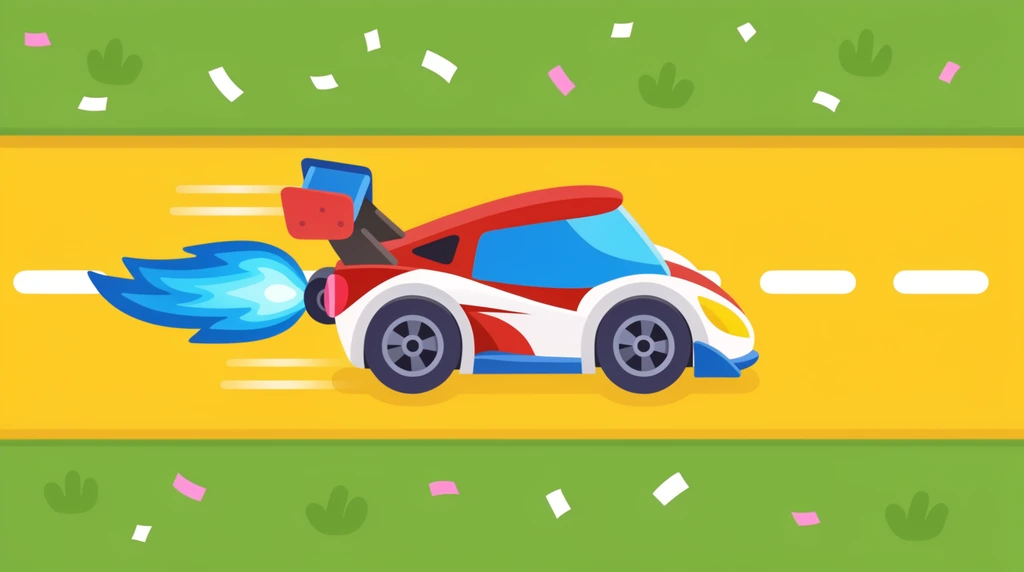
"You don't need to press the nitrogen all the time... when the gauge is full, you press it. But you don't hold it all the time. If you hold it all the time, you won't see this fire coming out from the exhaust. You need to wait, and then when you see that, you press."
That's a great clue to teach: the game gives you a visual tell. When the boost is ready, fire shoots out of the exhaust pipe. So you don't have to guess — you watch for the flames, then hit the boost. The whole lesson lands in one moment: timing beats spamming. A full-power boost fired at the right second is worth far more than dribbling it out the entire lap. Waiting is actually a skill.
Credits, upgrades, and running out of gas
Winning a race isn't the finish line — it's how Eon earns credits, the game's money. One reward pays out 25,000 credits, and his eyes go wide: "Oh my god... get a new car!" Then he learns what credits are for. You spend them on upgrades: Eon clicks the upgrade button and adds a stronger engine, better tires, and more nitrogen. He even plays it smart — "I want to save a little bit of money" — choosing not to spend it all at once. That's real budgeting tucked inside a racing game: more money buys a better car, but saving has value too.
He also runs into a surprise. Mid-game, one of his cars suddenly stops working. "Oh, it's gas being refilled — it ran out of gas. So you can't play this car. You have to change the car." So fuel is a limit, and the fix is to swap to a different car ("now the car is like this tank") and keep racing. Between races Eon also picks his track: he tours Scotland ("famous for mountains" — he wants the "tall mountain, a lot of trees"), says he wants to try New York, and ends up loving San Francisco ("yo, this car is clean!"). Same game, new city, new challenge.
Along the way, his coach slips in a bonus idea: merch. "You want to sell something of your branding — that's called merch," like a shirt with your own logo on it, and you'd need a domain name (a dot-com) to sell it. A little real-world business vocabulary, sparked by the shirt Eon is wearing in the video.
Try it
Next racing game you play, run a two-lap experiment with the boost. Lap one: hold the boost button down the whole time and notice how often it's even available — usually not much. Lap two: drift through the corners to fill the gauge, then fire the boost only when it's full (watch for the flames from the exhaust or a full meter). Time both laps. Which one was faster? Almost always, the saved, well-timed boost wins — exactly what Eon discovered. Earning it and waiting for the right moment beats spamming the button every time.