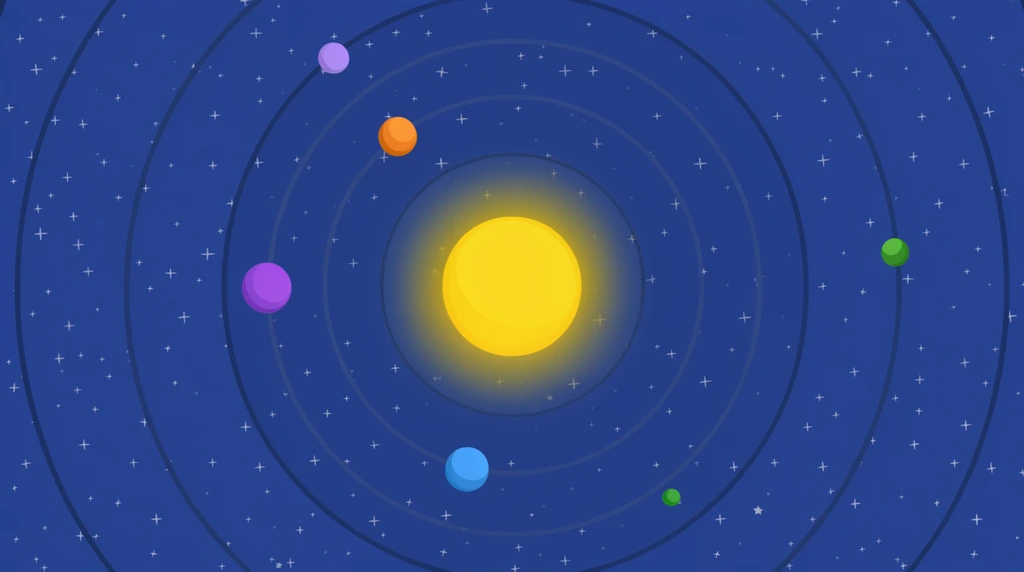
Eon is loose in Universe Sandbox, a game where you don't just look at space — you break it. Over one chaotic session he spawns stars and black holes, bakes a planet until it glows, rips an atmosphere off a world, and finally launches Pluto at Earth so hard the whole game crashes. It looks like pure goofing around (there is a "blue watermelon" planet), but tucked inside the chaos are three big science ideas: temperature, mass, and gravity.
Too hot for life: temperature changes everything
The best science in the video happens when Eon starts watching a planet's temperature. At first it reads about 5 degrees, then he nudges it and watches the number climb. "It immediately burned all of life," he says, "lava's going." A moment later: "baby have atmosphere." He has accidentally re-created what makes a world livable or deadly.
A planet's temperature decides what can exist there. Too hot, and oceans boil, rock turns to lava, and life can't survive. Just right, and a world can hold liquid water and an atmosphere (the blanket of gas around it).
Then comes the eerie part. As he cranks the heat even higher, Eon watches the air itself disappear: "All the atmosphere gone. And this is a ball of death." On the other end, he freezes a moon and calls it "a little bit creepy." One slider, two extremes — boiling lava on one side, frozen ice on the other.
Why spinning helps a planet cool
Here's a clever moment most kids would miss. When one side of his planet keeps burning, Eon decides to spin it: "so let's spin — it will cool down." That's real physics.
If a planet doesn't spin, the side facing the star roasts while the far side freezes. Spinning turns the whole surface toward the light and then away from it, sharing the heat so no single side burns up. Earth's daily spin is exactly why we get day and night instead of one scorched face.
More mass, more punch: the Pluto experiment
Next Eon tests mass — how much stuff an object is made of. He grabs Pluto and drags the mass slider as high as it goes: "I want to make the mass bigger... I'm going to make it the biggest." Then he launches it at Earth.
The result is bananas. Earth doesn't just get dented — it balloons into a giant blue blob he keeps calling a "blue watermelon." "Oh, the big game gave Earth mass because that Pluto is so big," he realizes. The game even crashes under the strain.
Mass is how much matter is packed into something, and mass creates gravity — the pull that holds you to the ground. More mass means more gravity, so a heavier object pulls harder on everything near it and hits with far more force in a collision. That's why slamming a super-massive Pluto into Earth caused total chaos.
He pushes it further with black holes, noticing a supermassive one is "more than the small one" — black holes aren't all the same size, and the biggest ones have unimaginable mass. He even tries a collision between two of them.
Learning by experimenting (yes, even when it crashes)
Notice Eon's whole method: pick something, change one setting, and watch what happens. He compares his giant planet to Jupiter ("Is Jupiter bigger than this?"), checks whether a melted world still has a "rocky" core, and keeps an eye on whether life survives. When the simulation finally breaks under a giant mass, that's not a failure — it's the experiment telling him he pushed past what's physically reasonable.
Real scientists do this too: change one thing at a time, observe the result, then try again. A crash or a weird result is data, not a dead end.
Try it
You don't need a black hole — you can feel mass and gravity with your hands. Wad up a sheet of paper into a light ball and roll a heavy marble or a small rock across a table at the same speed. Knock each one into a row of toy blocks. Which one scatters the blocks farther? The heavier object carries more punch — the same reason Eon's super-massive Pluto wrecked Earth. Bonus: spin a ball under a desk lamp and feel how every side gets warmed in turn, instead of just one face cooking.