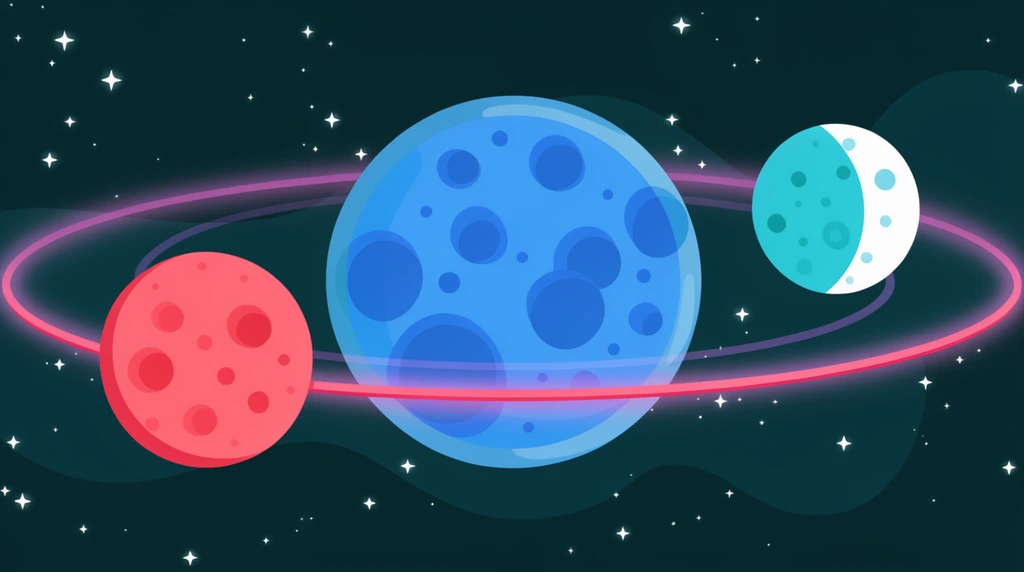
A big new update lands in Solar Smash, and Eon spends the whole video as a backyard space scientist on his iPad. The very first thing he notices is the headline feature: "the moon orbits around the planet." He flips on slow mode to get a proper look, launches a moon, and then keeps adding more — "I want to launch a lot of a ball" — until a second moon is looping the Earth too. "This is what happens if Earth has two," he says, watching them tangle. It is a goofy, chaotic playground, but underneath the explosions Eon keeps bumping into real physics — and one discovery genuinely surprises him.
Two moons, a dragon, and a giant new black hole
The update is packed, and Eon explores it like a kid unwrapping presents. He finds a dragon he can't fly, so he switches to target mode instead and "breathes fire into planet Earth." He meets a glowing virus-looking blue thing and runs a little experiment on it — "I'm just going to tap my pause screen 10 times in a row and see what this thing does" — which is exactly how a scientist pokes at something unknown: do the same action over and over and watch the result.
Then comes the star of the update: a brand-new, much bigger black hole. Eon remembers the old one and compares them out loud — "you guys all know what this small black hole did… it just a little bit damage. But this is the new black hole… look how big the crater is." Comparing the old version to the new version is how you measure what actually changed, and Eon does it without being told.
The living planet with a beating heart
One new world stops him cold: a living planet covered in creepy eyeballs that "hold back" and refuse to be destroyed. Most weapons bounce off, so Eon hunts for a weak spot. Using the gas cannon — which he calls "the strongest weapon, it literally goes through the entire planet" — he slices the planet open and finds something beating inside: "I see the heart! Look at the heart… you can see it go small and go big, small."
He's honestly stumped about why it's there, and instead of pretending, he asks his viewers a real question: "Can somebody let me know in the comments why this planet has a heart? Is it alive? Do planets have a heart like me?" That's a scientist move — when you don't know, say so and ask a good question. Earth isn't alive the way an animal is, but it does have a hot, churning core deep inside that never stops moving. Maybe that's the game's idea of a "heartbeat."
A speck that beats a sun
The biggest idea arrives when Eon parks a tiny black hole next to a giant star — and keeps repeating the thing he can't believe: "This black hole is 10 times smaller than the sun… but this black hole has more mass than that star." Then it happens: "It's tearing the mass off this star! It's literally just tearing the mass off." Glowing matter streams off the star and spirals into a dot so small he says "you can't even see the black hole, that's how tiny it is."
The thing doing the pulling isn't the big one — it's the heavy one. Mass is how much stuff is packed into an object, and mass is what makes gravity's pull. A black hole is so unbelievably dense that even a speck can hold more mass than a star a thousand times wider. So the speck wins. Size and mass are not the same thing: a beach ball is big but light; a cannonball is small but heavy, and gravity follows the cannonball.
Eon also notices the star starting to react — "Is it going to supernova?" — and he's onto something real. A star is a constant tug-of-war between its own gravity pulling in and its heat pushing out. Steal enough of its mass and that balance breaks, so the star can swell, shrink, or blow apart in a supernova.
Catching the orbit (the hard part)
Eon makes orbits look easy, but listen closely and you hear him failing and adjusting, which is the real lesson. Lining up a black hole to circle a star, he keeps over-shooting: "I don't want to crash into the star… most times I just speed up and the star just explodes." He nudges the distance — "maybe that's too far away" — and tries again and again. He even tries to build a new planet by throwing Venus at Earth and keeps missing: "Wait, I miss again."
An orbit is a balance of speed and distance. Go too slow or aim too close and gravity yanks you straight in (crash). Go too far or too fast and you drift off into space. Hitting the sweet spot in between — a stable loop — takes practice, and Eon's repeated "let's go again" is exactly how you learn it.
Try it
Find two balls of very different sizes — a big foam or beach ball and a small metal one like a marble. Before you weigh them, guess: which is heavier? Then put them on a scale. The bigger ball usually isn't the heavier one — and gravity cares about mass, not width. That's the whole reason Eon's tiny black hole ate a giant star.
Next, try Eon's habit the next time you play any simulation game: turn on slow-motion or pause and watch one thing closely. Pick a single moon, star, or planet, predict what will happen, then slow it down to check if you were right. Fast and frantic, you see nothing; slowed down, you catch the matter peeling off the star — and you start thinking like a real space scientist.