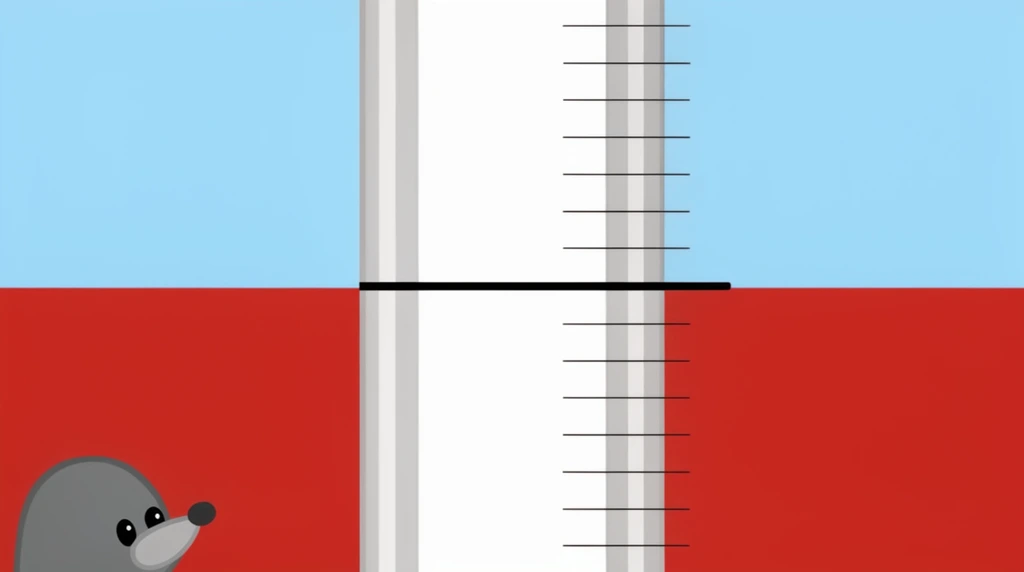
"To be honest, we're quickly going to review what we already learned," Eon says at the start — positive numbers, negative numbers, greater than, less than. Then the lesson pushes into new territory: the numbers hiding between the whole numbers, and the strange world to the left of zero. It all happens on a number line Eon's dad built, where you can grab the line with the mouse and zoom right in.
Decimals: zoom in and find the hidden numbers
Eon's dad wrote some code so the mouse wheel zooms the number line. "Zoom in between zero and one to see what happens," he challenges. Eon scrolls — and the gap between 0 and 1 spreads open, with brand-new numbers appearing inside it. Keep scrolling and eventually the program stops: "this is the limit." But the idea is that the gap is never really empty.
So what lives in there? Eon's dad drags the marker around and reads off what it lands on:
- 0.46 — "greater than zero but less than one. It's in between."
- 0.77 — same deal, sitting between 0 and 1.
- 1.5 — this one is "less than two but greater than one," tucked between 1 and 2.
That's the whole secret of decimals: every one of them is squeezed between two whole numbers, and zooming in is how you go looking for it.
Negatives: drag left of zero
Now the trickier move — slide the marker to the left of zero into the negative numbers. They can be decimals too. Eon's dad parks it on −2.45 and asks: "Greater than minus 3, or less than minus 3?"
Eon's first answer is "less." His dad says, "Think again… is this number greater than minus 3, or less than minus 3?" Eon switches: "Greater." Yes — −2.45 is greater than −3 because it's on the right side. That right-side rule is about to matter a lot.
To make it stick, Eon's dad draws a building. The ground floor is 0. Go up and you get the first, second, third floors — +1, +2, +3. Take the elevator down to the parking levels and you hit B1 and B2 — and in math those are −1 and −2. Negative numbers are simply the floors below the ground. Want to go even more negative? Picture a boring machine drilling toward the center of the Earth — "really, really below the ground."
The tricky bit: which negative is bigger?
Because "further right = bigger" never changes, negatives surprise everyone at first. Eon's dad fires off challenges:
- −9 vs −1? Eon nails it: −1 is greater — it's further right, closer to the ground floor. A big number with a minus in front is actually "really small, to be honest."
- −7 vs −3? −7 is less, because it's further to the left.
- Then the one his dad flags as a trick question: −5 vs −6. Eon gets it: −5 is greater. Normally 6 beats 5, but "I flip the sign, I flip the side" — −5 sits one floor above −6 in the basement.
"I think you already mastered it," his dad says. High five.
Try it
You're on the elevator. Two basement buttons: B3 and B8 — that's −3 and −8. Which floor is higher up (the greater number)? Then check yourself the Eon way: picture the building, find which one is further right / closer to the ground. (It's −3 — only three floors down instead of eight.)