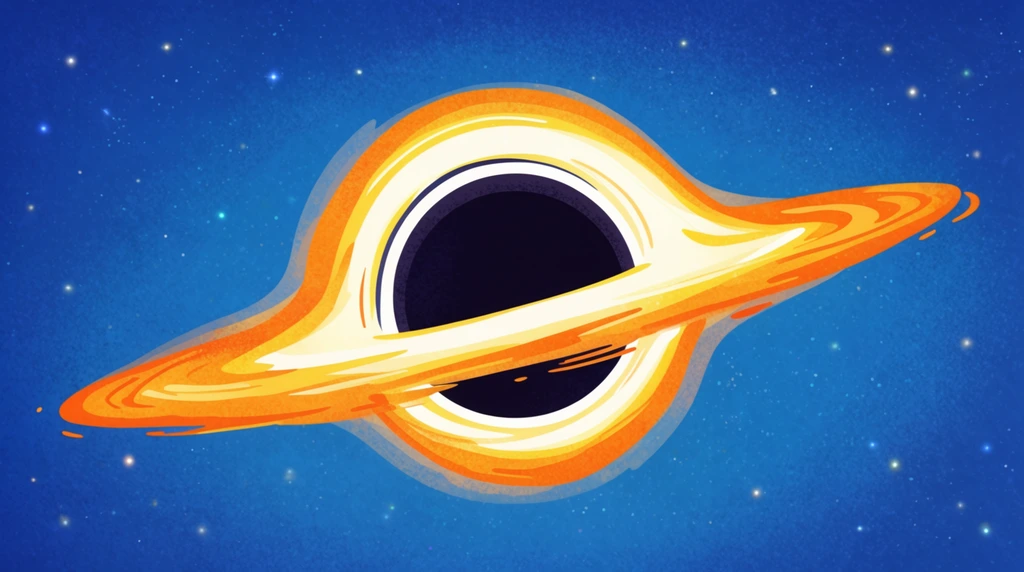
This is the moment the whole Modeling Lab series has been building toward. Eon and his dad are about to sculpt a supermassive black hole in Nomad Sculpt — the 3D app on a tablet. They start the video pumped up: "This is the moment you've been waiting for, because it is the moment of us creating a supermassive black hole." They settle on a name for their monster: Sagittarius 8, a nod to the real supermassive black hole at the center of our galaxy.
Step one: a giant black ball
Eon's plan is refreshingly simple: "A black hole is black, so you just need to add a really huge sphere and make it black." That's actually solid science. A real black hole is matter squeezed so dense that its gravity lets nothing escape — not even light. No light coming out means we see a black shape, so a black sphere is the honest starting point.
In Nomad Sculpt, Eon does it step by step: tap Add (+), choose a UV sphere, then use the gizmo (the move tool with arrows) to slide it across the scene. Then he cranks up the radius to make it enormous.
But he learns a real lesson the hard way. He blows the sphere up so big that it fills the whole screen, and his dad laughs: "You just made a mistake, because you left no space for you to zoom out." The fix is to make the ball big but leave room to see it. So they invent a system: "You control the radius. I control the zooming in and out. That's called teamwork." One person changes the size, the other keeps the camera pulled back so they can see what's happening.
One more thing before moving on: Eon has to tap Validate. In Nomad Sculpt, a new shape stays adjustable until you "validate" (lock in) the settings — and the app auto-saves right after. Then he changes the color and hits Paint all to coat the whole sphere black. "That already looks like a black hole!"
The torus: a donut you can flatten
A black ball is a start, but Eon remembers the part that makes a black hole look like a black hole: "We've got an accretion disc." Around many real black holes, gas and dust spin so fast they heat up and glow — that bright, flat ring around a dark center is the shape you see in the famous photos.
How do you model a ring? Eon's dad introduces a brand-new 3D shape: a torus. "It's like a donut, right?" And here's the clever idea — an accretion disc is basically "a flattened-out version of a torus," like Santa's sleigh ring squished super thin.
So they add a torus and play with two settings: outer radius (how wide the whole ring is) and inner radius (the size of the hole in the middle). At first it comes out puffy and pale: "That's a white donut. We need to flatten things out." The trick is to switch to the top view so they can look straight down, then squash the torus until it's a thin, wide disc hugging the black sphere. "There we go — that's what I'm talking about!" They nudge it with the gizmo so the dark center peeks through the glowing ring. Black sphere plus flattened glowing torus finally reads as a real black hole.
How big is "supermassive"?
The best part is the ending, when they line up the black hole next to everything else they built in earlier labs. They drop in a planet, a gas giant, a star, and even a pyramid — and each one looks tiny. "This is planet Earth, and this shows you how microscopic the Earth is." Eon describes it perfectly: Earth is like "a tiny little speck of sand in a desert." Even the "rainbow gas giant" almost disappears, and the pyramid looks like it "disintegrated."
That comparison is the real science lesson. "Supermassive" isn't just a cool word — a black hole like Sagittarius A* is so huge it could "eat a whole star," and our entire planet is just a speck beside it. Building the model to scale is what makes that size feel real.
Try it
Grab a ball of clay or play dough and roll it round — that's your sphere, the black hole. Now roll a second piece into a snake and join the ends into a ring: you've made a torus (donut). Press that ring flat with your palm until it's thin and wide, then set it around the ball so the center shows through. You just did the exact two moves Eon used: a sphere for the black hole, and a flattened torus for its glowing disc. Bonus: set a pea next to it for "Earth" and see just how microscopic our planet would be.