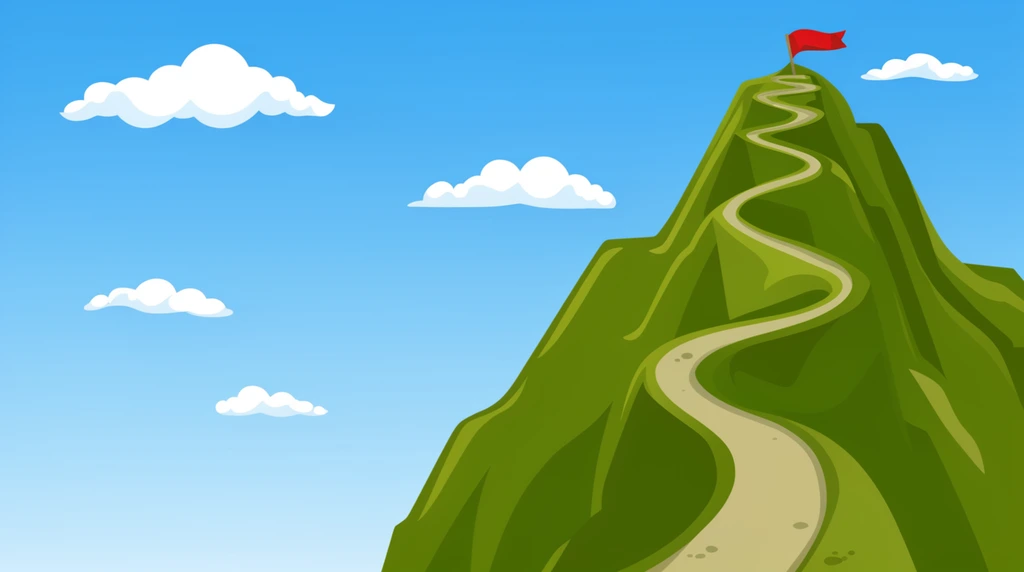
No game today — Eon is outside, standing at the bottom of what he proudly calls "the steepest mountain in the world." It starts with him saying "this is easy"... and one second later there's a slip, a scream, and a burst of laughter. By the end he's climbed, slid, crossed a tricky stretch, switched to a better path, and walked right into a "tunnel forest." The whole adventure is packed with real outdoor science.
Why "steep" is the whole problem
Eon names the challenge before he even starts: the steepness. That's the perfect word, because steepness is exactly what makes this climb so hard.
On flat ground, gravity pulls you straight down into the floor and you stay put. On a steep slope, that same downward pull also tugs you backward down the hill. The steeper it gets, the stronger that backward tug feels — which is why Eon keeps sliding and gasps "so steep!"
You can hear how much harder his body is working: every step forward has to fight the mountain trying to send him back. That's not Eon being clumsy — that's physics doing exactly what physics does on a hill.
"It's not a slide!" — the science of slipping
The funniest moment is when someone slides backward and Eon insists, "It's not a slide — I know it's not a slide!" But the ground keeps acting like one. Why?
The answer is traction, which means grip between your shoes and the ground. Loose dirt, dust, or smooth rock gives your feet less traction, so instead of pushing you up, your foot just skids. Eon describing how "you slip all the way over" is low traction in action.
This is why the family keeps shouting "be careful," "mind your step," and "mind it." On a low-grip slope you move slowly and plant each foot on purpose, testing whether it will hold before you trust it with your weight.
Tools and teamwork: the stick and the better path
Eon doesn't just power through with his legs — he gets smart about it, and that's the best part to copy.
First, the stick. "Stick — go first," he says, using a branch like a walking pole. A stick gives you an extra point of support: instead of balancing on two feet, you balance on two feet and the stick, like adding a third leg to a wobbly stool. It tests the ground ahead and steadies you when a foot slips.
Second, the better route. After one rough stretch, Eon decides "this way is better" and changes direction. Real climbers do this all the time — when one path is too slippery or steep, you look for a gentler line up. Choosing a smarter path is just as clever as climbing harder.
And through all of it, listen to the team: "Come on! Keep going! You can do it!" That steady stream of encouragement is what turns "I want to quit" into one more step — until Eon finally shouts the best two words in the video: "I made it!"
Earning the thumbs up
At the top, Eon asks the camera for a thumbs up — and then flips it around to you: "If you climb this mountain, let me know how far it is." He's proud on purpose. Easy things don't feel like much, but a hard climb — the slipping, the careful steps, the not-quitting — makes reaching the top feel huge. And as Eon reminds everyone, "that is all the beginning," because the adventure keeps going right into the forest.
Try it
Find your own small, safe "mountain" — a grassy hill, a playground climber, or a gentle trail with a grown-up. Try two experiments:
- Feel the steepness. Walk up the flattest part, then the steepest part. Where do your legs work harder? That extra effort is gravity pulling you back.
- Test traction. Notice where your shoes grip and where they slip — grass, dirt, gravel, smooth stone. Then pick up a sturdy stick and use it like Eon did, and see how much steadier you feel.
When you reach the top, give yourself a thumbs up. You earned it the same way Eon did — by slipping, laughing, and trying one more time.