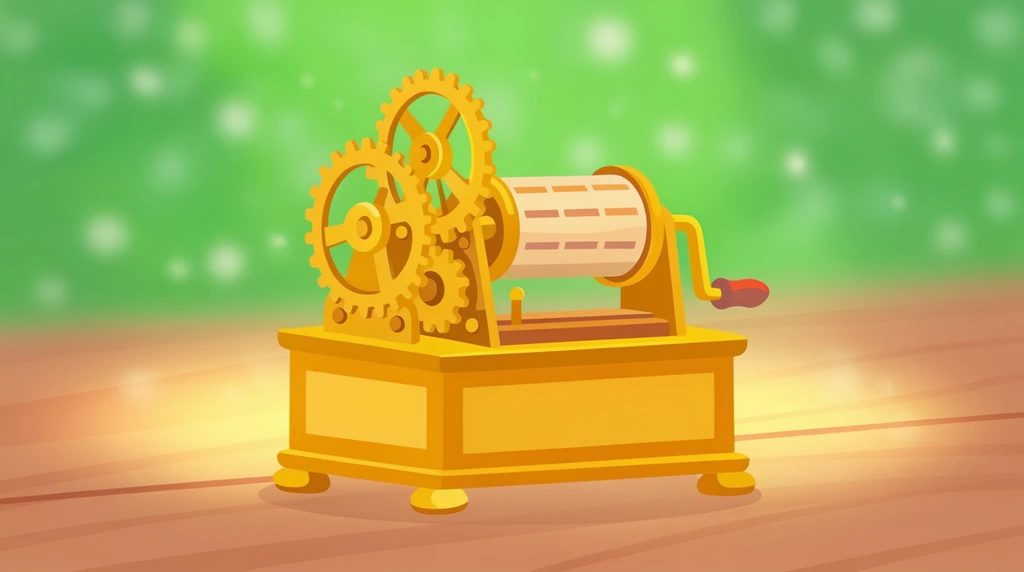
This one is a quick show and tell. Eon says right up front it's "a really short video," and he just wants to show you the cool little things around him. The star is a "little cute guy" he calls a mechanism — but he also shows a frog, a magnet that spins, a mini piano, and a watch he's had for years. Let's look at the science hiding inside the everyday stuff on his desk.
The "mechanism": parts that work together
Eon picks up the music box mechanism and uses the perfect word for it over and over: mechanism. He screws pieces on top — "you get three things there" — then he rotates it and watches it spin. "This just spin. Look at this!"
A mechanism is a group of parts that work together to do one job. When you turn the top, that turning travels down through the inside parts and makes the whole thing move. Turn one part, and another part responds — that's the whole idea of a machine, from a music box to a bicycle.
He even adds a frog with "a little way on the bottom" and tries a bigger piece — "it too big, so let's put it on the side." Noticing that a part is the wrong size to fit is real engineering thinking: parts have to match to work together.
Looking at the bottom and the inside
The best moment is Eon's curiosity. He flips the mechanism over to show "the bottom, how the mix like… see on the top like this way," and then points out "the inside part right there. See a hole."
You learn how something works by looking where you normally don't — the bottom, the back, and the inside. That hole and those hidden parts are the secret of the machine. Engineers are just people who keep asking "what's in there?"
A magnet you can spin
Later Eon shows off a magnet sitting near his computer. "You can spin this. Let me show you guys… Bam!" He laughs that he's "so bad at this," but he keeps it spinning and compares it to "a lollipop."
A magnet has an invisible force that can push and pull other magnets and some metals without touching them. That force is why a magnet can keep spinning, snap onto your fridge, or stick to a metal desk. Eon is careful, too — he reminds himself to "not hit the computer and not destroy it," because magnets and electronics don't always mix.
Big vs. small: the mini piano
Eon points at "a small piano right there" and explains it's "the small version of the big piano" he already has — "that little bit big and large, and this is the small version."
Making a small version of a real thing is super useful. A mini piano lets you hold, compare, and understand the big one. When you put a small thing next to a big thing, you can see what's the same (the shape, the keys) and what's different (the size). Comparing sizes is how scientists describe the world.
He does the same trick with a watch he calls the "ET5," saying he's had it "like 10 years" and just "broke this part of it" — then presses the button and it still works. Old, well-built things that keep working are their own kind of cool.
Try it
Find one small everyday machine — a wind-up toy, a music box, or a pen with a clicker.
- Make it go, then turn it over and look at the bottom and inside. Can you find the part that moves first when you press or turn it?
- Hunt for a magnet (a fridge magnet works). Without touching it, see what it pulls toward — paper? a coin? a steel spoon? Notice that it only grabs some things.
- Compare sizes: put a small version of something next to the big one — a toy car and a real car in a photo, or a mini and a full piano. Write down one thing that's the same and one thing that's different.
You just did what Eon did: looked closely, compared, and figured out how the little machines around you really work.