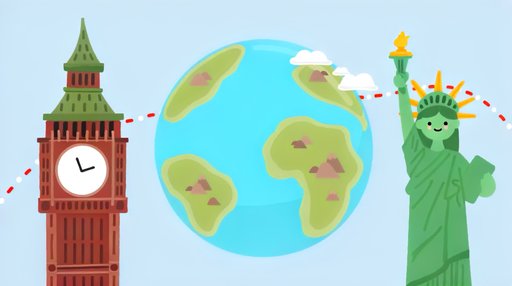
Eon launches a brand-new series — Eon the Explorer — to travel the world from his screen and learn the history of famous places. The whole idea started at home: his family hung a big world map on the wall, then bought a clock so large it covered "half of China and Japan" and left just one dot of the map showing. That giant clock gave Eon a huge interest in another giant clock — Big Ben — so the first quest was set: find Big Ben yourself. This article follows the real tools and tricks Eon used to pull it off.
Finding Big Ben on Google Earth
Eon's first move was the search button. He typed "Big Ben," and Google Earth flew the camera straight to a red dot in London, then let him switch to a 3D view of the real tower. He learned a few real navigation skills along the way:
- Street View: click the little "person" button, then click anywhere that glows blue, and you drop down to walk the streets like a person standing there.
- Time travel with photos: a label in the corner read July 2024 and August 2024. Eon realized different photos were taken at different times, so you can switch between them to see what a place looked like in a particular month.
- Reading the world: spotting a flag, he learned it's the Union Jack, the flag of the United Kingdom — and that every country has its own flag.
He cruised over Westminster Bridge to the London Eye and called it a roller coaster. His dad corrected him: it's not a roller coaster, it's an observation wheel — a giant wheel you ride to get a view. Eon also visited The Shard and found it full of offices, and learned that the little camera icons on the map mark famous attractions you can jump to.
The measuring tool — a sneaky geometry lesson
Google Earth has a measure tool, and Eon used it to ask: how long is Westminster Bridge? You drop a starting point, then a second point, and it gives you the distance. But he discovered something important about measuring.
Going straight across, the bridge measured about 244 meters. But when he wandered the points in a curvy, zig-zag line, the number jumped up to 274 and kept climbing. His dad explained the rule: to measure how long something really is, you go straight from one end to the other. Wander off in a zig-zag and you get a bigger number — the wrong measurement, because a crooked path is always longer than a straight one. That's a real geometry idea: the shortest distance between two points is a straight line.
Chaining tools to climb the Statue of Liberty
For the second landmark, Eon flew across the Atlantic Ocean to New York and the Statue of Liberty on Liberty Island. But here he hit a wall: Google Earth would only show photos around the base of the statue — he couldn't get inside or up to the torch. Instead of giving up, Eon did something clever: he switched tools.
- He opened Google search and typed "360 torch statue of liberty."
- The AI overview explained that the National Park Service offers a virtual tour — like VR — so you can explore without physically climbing.
- He opened that tour. When his iPad couldn't run it, he didn't quit — he moved to a Mac browser and got it working full-screen.
That's a real problem-solving skill: when one tool can't do the job, chain another tool onto it. Inside the tour, Eon climbed the spiral staircase up the inside "shell" of the statue, rested at a balcony, passed signs for the crown and face, and finally reached the torch. He noticed the climb was "only up" — like the video game Only Up — and that the rusty old torch ladder is now closed because it's too dangerous. From the top, he got the best view of New York City.
Along the way Eon also learned a calmer truth about technology: when Google Earth froze and everything got stuck, the fix was simply to exit and re-enter — it's not a game, it's a tool, and tools sometimes need a restart.
Try it
Open Google Earth and run Eon's quest. Search "Big Ben," switch to 3D, then click the person button and a blue spot to walk the London streets. Now fly to "Statue of Liberty" in New York. As you go, answer two questions: Which landmark is in Europe and which is in North America? (Big Ben → Europe; Statue of Liberty → North America.) Then try the measure tool on any bridge: measure it once in a straight line, then again in a zig-zag — and see for yourself which number is bigger, and why.