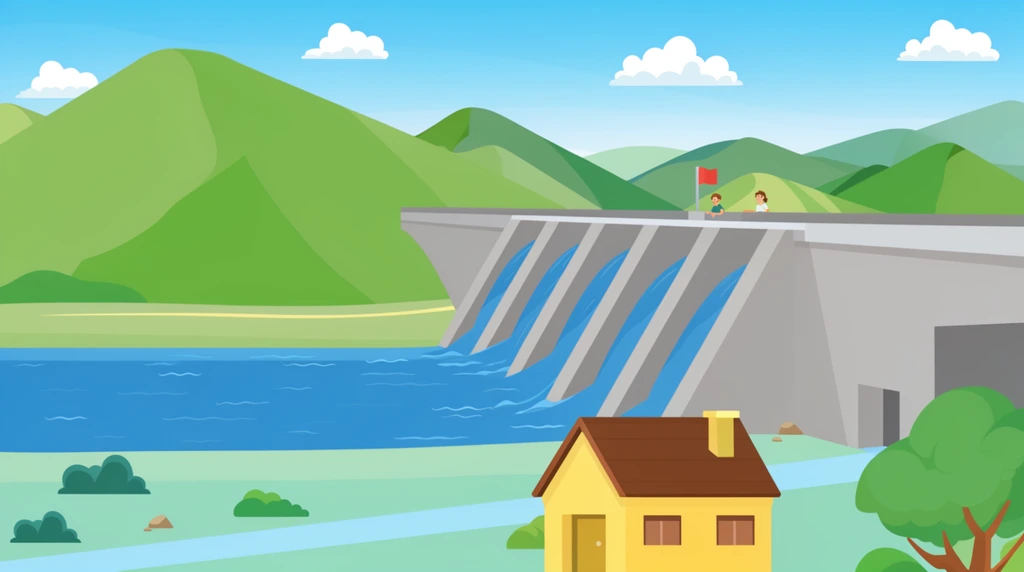
In this clip, Eon sees a dam for the very first time. There's a big build-up — "three, two, one… oh my goodness!" — and a burst of laughter. It's a tiny, excited moment, but a great question hides inside it: what is a dam, and why do people build such an enormous wall across a river?
What Eon was looking at
A dam is a big, strong wall built across a river. A river always wants to flow downhill, so the dam stands in its way and holds the water back — kind of like putting your hand across a stream of water and watching it pile up. That piling-up is the whole point. A dam isn't there to stop the water forever; it's there to collect and control it.
A wall holding back a whole river has to be tough. Real dams are some of the biggest things people ever build, made of thick concrete or piled-up rock and earth. The first time you see one — like Eon just did — the size alone is enough to make you go "oh my goodness."
Why do we build dams?
Once the dam holds the water back, the river spreads out behind it into a big calm lake. That lake has a special name: a reservoir. Builders make dams for a few real reasons, and the reservoir is the key to all of them:
- Store water. The reservoir saves up water so towns and farms have some even when it hasn't rained in a while.
- Stop floods. Instead of a sudden rush racing downstream, the dam lets the water out a little at a time, so the land below doesn't flood.
- Make electricity. Here's the coolest part. When water is let through the dam, it falls and rushes fast. That moving water can spin big machines inside the dam, and spinning machines make electricity — the same electricity that lights up a house. Electricity made from falling water is called hydropower ("hydro" means water).
So one giant wall does three jobs at once: it saves water, calms down floods, and quietly powers homes. No wonder a dam is worth a big "three, two, one" countdown.
Try it
You can build a tiny dam of your own. Outside, find a little stream of water — a trickle in the gutter after rain, or water from a hose running across some dirt. Pile up sand, rocks, or mud across the flow to make a wall, and watch the water back up into a little pond behind it. That pond is your reservoir! Now poke a small hole near the bottom and watch the water shoot out fast — that fast, falling water is exactly what a real dam uses to make electricity.